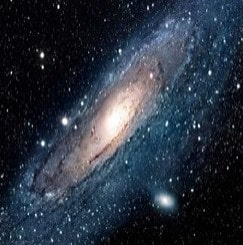
There are estimated to be over 100 billion galaxies in the observable universe, each containing billions of stars.
The Milky Way, our own galaxy, is a barred spiral galaxy that is estimated to be around 13.5 billion years old.
The largest known galaxy, IC 1101, is estimated to be around 6 million light-years across and contains trillions of stars.
Galaxies can collide and merge, sometimes resulting in the formation of a larger galaxy. The Milky Way is currently in the process of merging with the nearby Andromeda galaxy.
Active galactic nuclei, or AGN, are regions at the center of some galaxies that emit high-energy radiation and jets of particles. These are thought to be powered by supermassive black holes at the galactic center.
Some galaxies have a high rate of star formation, resulting in the formation of large numbers of massive, short-lived stars.
Dwarf galaxies are small, low-mass galaxies that are much less luminous than larger galaxies. They are often used to study galaxy formation and evolution.
Some galaxies have an irregular shape, with no clear spiral or elliptical structure. These are often the result of recent mergers or interactions with other galaxies.
The Hubble Ultra-Deep Field, a series of images taken by the Hubble Space Telescope, captured some of the most distant and ancient galaxies ever observed.
Galaxies can also contain dark matter, an invisible substance that is thought to make up around 27% of the total mass of the universe. The gravitational effects of dark matter can be observed on the distribution of visible matter within a galaxy.