
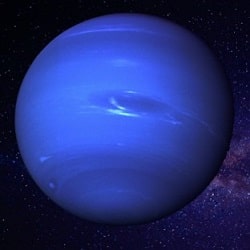
Amazing Facts About Planet Neptune – 15 Most Interesting and Unknown Things You Should Know
Planet Neptune, the eighth and farthest known major planet from the Sun, is a world full of extreme weather, deep mysteries, and astonishing scientific surprises. As the fourth-largest planet and the second ice giant after Uranus, Neptune holds secrets that astronomers are still uncovering.
Here are the 15 most important, fascinating, and little-known facts about Neptune that every space enthusiast should know.
1. Neptune Is the Farthest Planet From the Sun
Neptune orbits at a distance of about 4.5 billion kilometers from the Sun.
Because of this enormous distance, sunlight on Neptune is 900 times weaker than on Earth.
2. It Was the First Planet Discovered by Mathematical Prediction
Unlike Uranus, which Herschel saw directly, Neptune was discovered in 1846 after astronomers noticed Uranus was being pulled by an unseen object.
Calculations by Urbain Le Verrier and John Couch Adams led to the planet’s discovery—confirming Neptune before anyone had seen it.
3. Neptune Is an Ice Giant Rich in Water, Ammonia & Methane
Like Uranus, Neptune is classified as an ice giant.
Its interior is dominated by water, methane, and ammonia ices, giving it a unique structure very different from Jupiter and Saturn.
4. Neptune Has the Fastest Winds in the Solar System
Winds on Neptune can reach a mind-blowing 2,100 km/h (1,300 mph).
These supersonic winds are faster than any wind recorded on any planet, including Jupiter.
5. The Great Dark Spot: Neptune’s Mysterious Storm
Neptune is known for the Great Dark Spot, a massive storm similar to Jupiter’s Great Red Spot.
It appears and disappears unpredictably, showing highly dynamic weather systems.
6. Neptune Radiates More Heat Than It Receives
Although Neptune is extremely far from the Sun, it emits 2.6 times more heat than it receives.
The source of this internal heat is still a scientific mystery.
7. Neptune Has Thin, Dark Rings
Neptune has at least five main rings, but they are very faint and difficult to detect.
The rings contain dust, icy particles, and dark organic materials.
8. Triton: Neptune’s Largest Moon Orbits Backwards
Triton, the largest moon of Neptune, has a retrograde orbit, meaning it moves in the opposite direction of Neptune’s rotation.
This proves Triton was likely a captured object, possibly a dwarf planet from the Kuiper Belt.
9. Triton Has Active Geysers
Unlike most icy moons, Triton has nitrogen geysers that erupt from below its surface.
This indicates active geological processes on a world colder than –235°C.
10. A Day on Neptune Lasts About 16 Hours
Despite its enormous size, Neptune rotates quickly.
One Neptune day (one rotation) is 16 hours, slightly shorter than a day on Uranus.
11. Neptune’s Year is 165 Earth Years Long
Neptune takes 165 Earth years to complete a single orbit.
The planet has only completed one full orbit since its discovery in 1846.
12. Neptune Appears Calm but Has Extreme Weather Below the Clouds
Though the visible surface looks smooth, deeper layers reveal massive storms, cloud bands, and fast-moving vortices.
Its weather system is one of the most violent in the solar system.
13. Methane Gives Neptune Its Deep Blue Color
Methane gas absorbs red light and reflects blue, giving Neptune its vivid deep blue appearance.
Although Uranus also contains methane, Neptune appears more intensely blue, suggesting additional unknown atmospheric components.
14. Neptune Has a Highly Tilted Magnetic Field
Similar to Uranus, Neptune’s magnetic field is tilted about 47 degrees and is offset from the planet’s center.
This creates unusual magnetic regions and auroras.
15. Neptune is a Gateway to the Kuiper Belt
Neptune’s orbit marks the inner boundary of the Kuiper Belt, a vast region of icy bodies including Pluto.
Its gravity shapes the orbits of many Kuiper Belt Objects (KBOs), making Neptune crucial to understanding the outer solar system.
16. Now accept the Challenge and Take a Quiz Trivia on Planet Neptune
18 Watch our Video Quiz on Planet Uranus on YouTube Video