
Amazing Facts About Planet Venus – Earth’s Mysterious Twin
Planet Venus is often called Earth’s twin, yet it is one of the most hostile places in the solar system. From scorching temperatures to poisonous clouds, Venus is full of astonishing features that make it unique and fascinating. Here are 15 of the most important and amazing facts about Planet Venus, written in a simple and engaging way.
1. Venus is the Brightest Planet in the Night Sky
After the Moon, Venus is the brightest natural object visible from Earth. It reflects sunlight strongly because of its thick cloud cover.
2. Venus is the Hottest Planet in the Solar System
Even though it is not the closest to the Sun, Venus is the hottest planet. Its surface temperature reaches around 465°C, hot enough to melt lead.
3. Venus Has a Runaway Greenhouse Effect
Venus’ thick atmosphere traps heat, creating an extreme greenhouse effect that has been running for millions of years, making the planet incredibly hot.
4. A Day on Venus is Longer Than Its Year
Venus rotates very slowly. One full rotation takes 243 Earth days, which is longer than the 225 Earth days it takes to complete one orbit around the Sun.
5. Venus Spins Backward
Venus rotates in the opposite direction to most planets, including Earth. On Venus, the Sun rises in the west and sets in the east.
6. Venus Has a Very Thick and Toxic Atmosphere
The atmosphere is mostly carbon dioxide, with clouds of sulfuric acid. The pressure on Venus’ surface is 90 times that of Earth — similar to being 900 meters underwater.
7. Venus Has No Moons
Like Mercury, Venus has no natural satellites orbiting it.
8. Venus Has Constant Cloud Cover
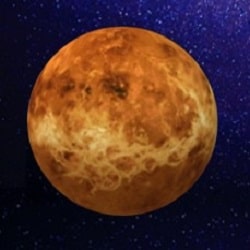
Thick sulfuric acid clouds cover the entire planet. Because of this, no human can see Venus’ surface directly from space using normal cameras.
9. Venus Has Volcanoes and Lava Plains
Its surface is covered with volcanic features. Scientists believe Venus has more volcanoes than any other planet in the solar system.
10. Venus Has Very Slow Winds at the Surface
Near the ground, winds blow only a few kilometers per hour. But higher in the atmosphere, winds can reach 300–400 km/h, circling the planet in just 4 days.
11. The Atmosphere Rains Acid
Although the rain evaporates before reaching the surface, Venus has sulfuric acid droplets falling from the clouds — a deadly form of acid rain.
12. Venus is Almost the Same Size as Earth
Because of similar size and mass, Venus is often called Earth’s “twin planet,” though the two worlds are extremely different in conditions.
13. Venus Reflects Sunlight Very Efficiently
Venus has a high albedo, meaning it reflects about 75% of the sunlight that falls on it. This is why it appears so bright from Earth.
14. Venus Has Been Explored by Many Spacecraft
Soviet Venera missions were the first and only landers to survive (briefly) on Venus. NASA and ESA have also sent orbiters. New missions — DAVINCI+, VERITAS, and EnVision — will explore Venus in the coming years.
15. How Venus Compares With Earth
- Venus has a diameter of about 12,104 km, only slightly smaller than Earth’s 12,742 km, and its mass is roughly 82% of Earth’s.
- A single day on Venus is extremely long — it takes about 243 Earth days to complete one rotation, and it rotates in the opposite (retrograde) direction, making the Sun appear to rise in the west and set in the east.
- Its year is shorter than its day, as Venus completes one orbit around the Sun in just 225 Earth days (0.615 Earth years), compared to Earth’s 365-day year.
- Venus also has a very small axial tilt of only about 3 degrees, which means it does not experience seasons like Earth, which has a significant tilt of 23.5 degrees.
- Moreover, the surface conditions on Venus are radically different, with temperatures reaching about 465°C and surface pressure about 90 times higher than Earth.
- Despite their similar sizes, Venus and Earth are worlds apart in their physical characteristics and environmental conditions.
16. If your weight on Planet Earth is 100 kg, then your weight on Planet Mercury will be 91 kg.
Click here to know your weight on other Planets
17. If your age on Planet Earth is 100 years, then your age on Planet Mercury will be 162.2 years. Strange! Isn’t it.
Click here to know your Age on other Planets
Now is the time to test your knowledge trivia on Planet Venus.
Also watch our Quiz on Venus on YouTube Video